How to Prepare for a HIPAA Audit
HIPAA audits are won or lost on the documentation you can produce in 10 to 30 business days. This guide walks through exactly what auditors ask for, what they accept, and how to be ready before the request lands.
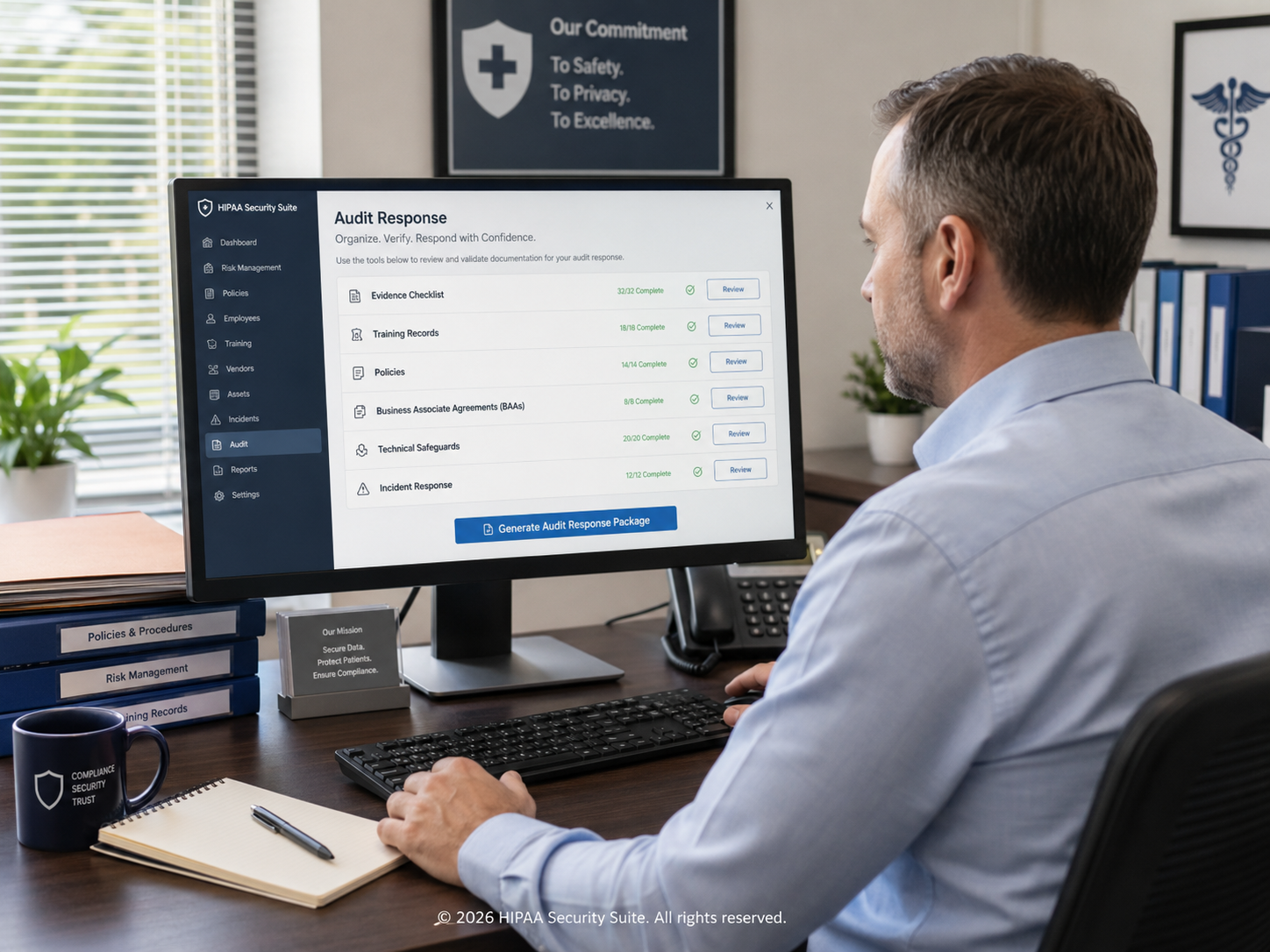
What HIPAA auditors actually look at
HIPAA audits and investigations rarely surprise organizations with exotic requirements. They consistently focus on the same controls:
Security Risk Analysis
Current, scoped, documented. "We did one years ago" rarely passes.
Risk Management Plan
Evidence that findings from the SRA have been prioritized and remediated, with dates and owners.
Workforce Training
Annual training with per-user completion records and certificates.
Policies & Procedures
Customized, current, reviewed — not generic templates dropped into a folder.
Business Associate Agreements
Signed BAAs for every vendor that touches PHI, current and findable.
Technical Safeguards Evidence
Encryption, audit log review, vulnerability management, access controls.
A 30-day audit prep plan
| Week | Focus | Deliverable |
|---|---|---|
| Week 1 | Inventory & gap analysis | List of systems, vendors, workforce roles, and current artifact status. |
| Week 2 | Refresh or complete the Security Risk Analysis | Documented SRA with scope, findings, and risk ranking. |
| Week 3 | Risk management & technical safeguards | Remediation plan with owners and dates; endpoint scan, patch, and encryption evidence. |
| Week 4 | Policies, training, BAAs, incident response | Current customized policies, training records, signed BAAs, and incident response plan. |
This plan is achievable for a small practice using a guided platform. Larger organizations should scale the timeline up and add a project owner.
What auditors usually do not accept
- "We have a folder of templates" without evidence they were adopted.
- Training that everyone "took" but no records exist.
- A risk analysis with no remediation plan attached.
- Vendor list with missing or expired BAAs.
- Encryption claims without configuration evidence.
- Incident response plans that have never been exercised.
How HIPAA Security Suite helps
| Audit need | How the platform helps |
|---|---|
| Current Security Risk Analysis | Guided SRA with versioned history and scope definition. |
| Risk management / remediation tracking | Every finding has an owner, date, and evidence trail. |
| Training records | Per-user video training with reminders and certificates. |
| Policies & procedures | Customizable policies, versioned and centrally stored. |
| Business associate agreements | Vendor & BAA registry with renewal reminders. |
| Technical safeguards evidence | NSS Agent scanning, breached-credential monitoring, CISA KEV tracking. |
| Incident response records | Structured incident log with breach evaluation steps. |
| Audit-ready reporting | One workspace produces the package on demand. |
Frequently asked questions
Who can audit a HIPAA-covered organization?
The HHS Office for Civil Rights (OCR) conducts HIPAA audits and investigations. Covered entities, business associates, payers, and accreditation bodies may also conduct reviews that look at HIPAA controls.
What documentation do HIPAA auditors typically request?
Current Security Risk Analysis, risk management / remediation plan, written policies and procedures, workforce training records, business associate agreements, incident response procedures, and evidence that technical safeguards are operating.
How long do you usually have to respond to a HIPAA audit request?
Response windows are often short — typically 10 to 30 business days depending on the type of inquiry. That is why pre-assembled documentation matters.
What is the single biggest cause of HIPAA audit findings?
Missing or outdated Security Risk Analyses, and missing risk management plans to address identified findings, are consistently among the most common HIPAA audit findings.
Be ready before the request lands
HIPAA Security Suite assembles the SRA, remediation plan, training records, policies, BAAs, and technical-safeguard evidence in one workspace — so audit response is a download, not a project.